
Ramayana is an Indian epic saga written by Valmiki on 250 BC, about the victory of goods to evil, and also about life morale stories. The epic travel to Thailand, Cambodia, Java and Bali, and through assimilation and acculturation has became local wisdom and manifested in many art form.
One of the most famous form of Ramayana in Java is manifested into relief along the wall of Prambanan temple. Prambanan temple was built in 9th century AD by Rakai Pikatan, king of Ancient Mataram. The relief has inspired GBPH Djatikusumo to create Ramayana Ballet in 1961.
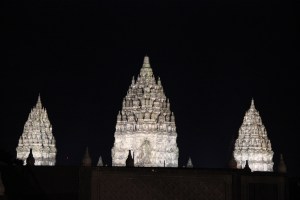
Ramayana Ballet performed in Prambanan Temple for the 1st time in the fullmoon of June 1961. Today it is performed at open theatre in dry season between May and November, and at Trimurti Theater in rain season between Oktober and May. In the bigger stage at open theater, the performance was supported by 250 dancers, while in the Trimurti Theater it supported by 50 dancers.
Like classical ballet performance, Ramayana Ballet was visualized by body movement, gesture, and facial expression by the dancer, without dialogue. To make it more dramatic, the performance use lighting and special effects. Some dancer even do juggling and archery, to make it more realistic. Music for the performance was played by live gamelan orchestra.
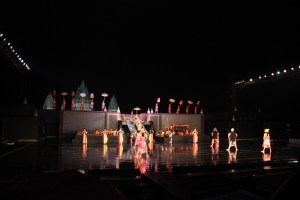
The ballet begin with the competition to decide who will be the right person to marry Dewi Sita, the princess of Manthili Kindom. It was Rama Wijaya, the prince of Ayodya Kingdom, who wins the competition and marry Dewi Sita. While walking in Dandaka Forest, Rama, Sita, and Laksmana (the brother of Rama) was watched by Prabu Rahwana, the King of Alengkadiraja. Believed that Sita was the incarnation of Dewi Widowati, the woman he loved and wanting for a long time, Rawana becomes eager to possess her, and kidnapped Sita.
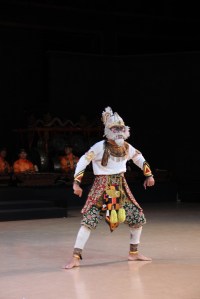
On the journey to save Sita, Rama and Laksmana met Hanuman, the white monkey knight. Rama and Laksmana agree to assist Hanuman in helping Sugriwa to defeat Subali, both are Hanuman’s uncles. After Subali was defeated, Sugriwa decided to help Rama to look for Sita, and sent Hanuman as envoy to Alengka.
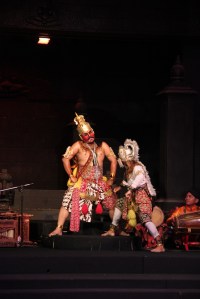
In Alengka, Rahwana tried to persuade Sita to be his wife, but Sita was refused to do so. Trijata, a niece of Rahwana, was try to comforting Sita. After Rahwana left them, Sita started to hear beautiful song sung by Hanuman. Hanuman told his purpose to help her, and the duty was ordered by Rama. Hanuman then try to find out the power of Alengka’s army, and after that destroyed the garden of Alengka, made him captured by Indrajit, Rahwana’s son. Hanuman was sentenced to be burn alive, but he freed himself and with fire around his body he burn Alengka’s palace.
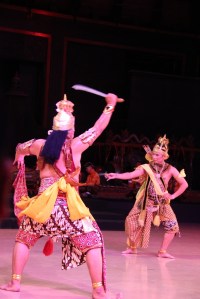
After Hanuman return to Rama, Rama and the ape troops go to the sea and make a bridge to Alengka. When the bridge is finished, Rama sent the troops to attach Alengka. The big war occurs between the giant troops of Alengka and the ape troops of Rama. In this war, Indrajit was killed by Laksmana. On the other hand, Kumbakarna, the younger brother of Rahwana, was died as patriotic hero, since he joint the war to defend Alengka as his country. At the final war, Rahwana was face-to-face with Rama, and killed by Rama’s arrow.
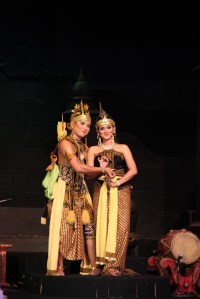
After the death of Rahwana, Sita, accompanied by Hanuman, meets Rama. But Rama refused to accept her, as he considered Sita was not pure anymore. In order to prove her purity, Sita burned herself. With the help of God of fire, Sita was saved from fire, and proofed that she stilled pure. This made Rama happy and finally accepted Sita.
 Rhien's Travel Journal