
Bengkulu, — or Bencoolen in English – is a city located at the west coast of Sumatera Island. Some people said that the name was derived from words “bend cut land” (“broken land”), indicating that Bencoolen was built at the fault zone, make Bencoolen one of city in the world with the most active earthquake. With population only 400.000 people. Bencoolen is the most quiet capital city in west part of Indonesia. But despite that fact, Bencoolen has many unique tourist attraction.
Panjang Beach
Panjang Putri Gading Cempaka Beach — nicknamed Panjang Beach– is the city beach of Bencoolen. The name “Panjang Beach” means “long beach”, since the beach lies 7 km long in the west side of Bencoolen. Facing the Indian Ocean, the beach has white fine sands and clear clean water. Different with most beach which has row of coconut trees, Panjang Beach has row of pine trees.
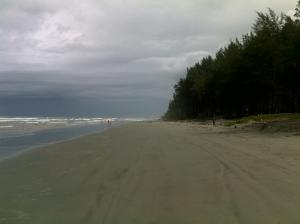
The beach is most favourite tourist attraction for local people. But we won’t see any tourist swimming at the beach, since the beach has strong rip current. Local people believe it is connected to the legend of Gading Cempaka, princess from Sungai Serut Sultanate. Once upon a time, a prince from Aceh Sultanate proposed to marry the princess. Princess Gading Cempaka refused the proposal, and it caused battle between two sultanates. To end the battle, the princess dive into the ocean. Legend said that she built kingdom in the bottom of the ocean, and become the guardian of Panjang Beach.
Fort Marlborough
Fort Marlborough is the historical icon of Bencoolen. The fort was built by East India Company (trading company of British Kingdom) in 1713. At their heyday, the fort was the second strongest EIC fort in Asia after Fort St George in Madras, and the biggest EIC fort in South East Asia. In 1823, the fort was handed-over to Dutch Indie Government, before it was handed-over to the Japanese in 1942. After Indonesia got their independence in 1945, the fort was used as military headquarter. In 1977, Indonesia government renovated Fort Marlborough and declared the fort as cultural heritage. The 44100 square meter fort was built on top of man-made hill. The fort architecture’s is looks like turtle, with 4 bastions in the corner as the turtle’s legs and the gate like the turtle’s head.
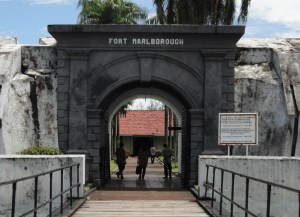
At the time of Japanese occupancy in 1942-1945, the fort was used to held prisoners-of-war, mostly Dutch nationalities. In one of the room used as prison, there was a compass painted by one of the prisoner-of-war. Below the compass, there was a message written in Dutch, translated: “Whoever watch the compass, please don’t be angry to one who made it, please remember that suffer and time made me draw and write this.” Maybe this was just the prisoner’s way to express his feeling..
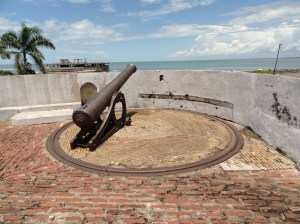
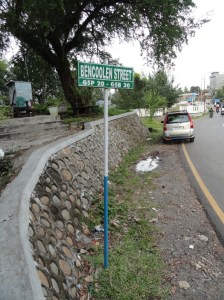
Standing at the bastion facing the Tapak Paderi beach, there was a Dutch-made canon. The canon was installed in a circle rail that made the canon can move in 360°. From this bastion, visitor can see the busy Tapak Paderi beach. Once it was a natural harbor of Bencoolen, but old locals remembered it as “Bomb Harbor”, since it was bombed during the attack to Fort Marlborough. There were Japanese bunker in the Tapak Paderi beach. The Tapak Paderi beach also a good place to watch sunset. Visitor also can take photo to sign written “Bencoolen Street” at the beach.
Only 300 meters from Fort Marlborough, at the front of Barukuto Market, visitor can find Thomas Parr Monument. Thomas Parr was EIC Resident at Bencoolen, who was stabbed and his head was beheaded on locals attacks at 1807. The Corinthian monument was built for his commemoration, while his tomb was inside Fort Marlborough. Local people call this monument Kuburan Bulek (Dome Tomb), because the roof of the monument has dome shape.
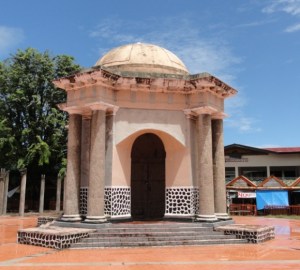
Bung Karno’s Exile House
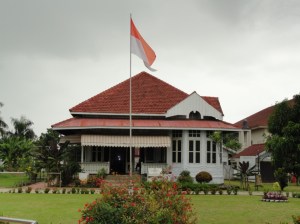
Bung Karno’s Exile House is the most favorite historical object at Bencoolen. Bung Karno, the first president of Indonesia, was exile to Bencoolen at 1939-1942. During that time, Bung Karno stay at the house of Tan Eng Cian at Anggut Atas area. Today, the house has preserved as museum, with displayed many heritage from Bung Karno’s time, like furniture, old bicycle, books, and old photos. The unique collection from this museum is 2 cabinets which keep costume of Monte Carlo Theater Group, the theater group which established and cared by Bung Karno.
Ibu Fatmawati’s Family House
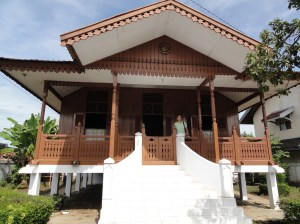
Ibu Fatmawati was the third wife of Bung Karno, and the first Indonesian First Lady. She was native from Bencoolen, and she met Bung Karno during the time of Bung Karno’s exile at Bencoolen. Before married to Bung Karno, Fatmawati stay at the family house near Simpang Lima. The house also preserved as museum. One of the special collection is sewing machine used by Ibu Fatmawati to constructed the first official flag of Indonesia (Bendera Pusaka).
Jamik Mosque
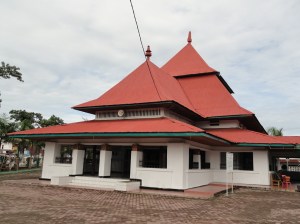
Jamik Mosque is the oldest mosque at Bencoolen, and also become famous because it was renovated by Bung Karno in 1938. The mosque has unique roof shape, compare to other mosque roof in Bencoolen which have dome shape. The roof of Jamik Mosque is storeyed, similar to Demak Mosque. The roof was made from zinc, like most house at Bencoolen. The zinc roof was more earthquake-proofed, therefore reducing the risk during the earthquake.
Tabot Tower
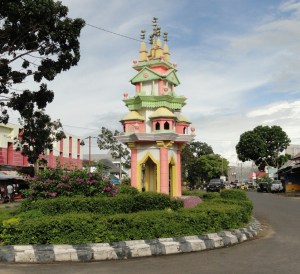
In (almost) every corner of Bencoolen, visitor can find a unique tower called Tabot. We can said that Tabot is (un)official mascot of Bencoolen beside Rafflesia flower. Tabot is storeyed-tower decorated with Islamic accessories using for Tabot Ritual, a traditional ritual to commemorate the heroic action of Hasan and Husein, the grandsons of prophet Muhammad Saw, who died at the Karbala War. Tabot Festival was held on 1st – 10th Muharram every year, and become one of the favourite tourist attraction at Bencoolen.
 Rhien's Travel Journal